Unlocking ROI with Multi-Touch Attribution Models
Let’s be honest—your marketing data is probably lying to you.
It's not malicious, but if you're only looking at the last click before a sale, you’re missing 90% of the story. This is where multi-touch attribution comes in. Instead of giving all the credit to one single interaction, it spreads the credit across the entire series of touchpoints that led a customer to convert.
Think of it as the difference between crediting only the final goal-scorer in a soccer match versus acknowledging the assists, the passes, and the defensive plays that made the goal possible.
Why Your Marketing Data Is Lying to You

The modern customer journey is a maze, not a straight line. Someone might see your ad on Instagram, read a blog post a week later, click an email link, and finally convert through a branded Google search.
If you only credit that final search click, your data is telling you to pour all your money into search ads. In reality, Instagram and your blog did the heavy lifting to build awareness and trust. This is the massive blind spot created by single-touch models like last-click or first-click attribution. They’re simple, but they’re wrong.
Before you can fix the problem, you have to admit you have one. This means understanding why your old methods might be flawed, especially if you’re trying to accurately calculate marketing ROI.
The Shift Toward a Complete Picture
Relying on a single touchpoint is like giving all the credit for a championship win to the person who scored the final point. It completely ignores the teamwork and strategy that set up the opportunity. Smart businesses are catching on and moving away from these outdated methods fast.
Multi-touch attribution gives you a far more honest and complete view of the customer journey. It helps you see how different channels work together, so you can finally put your budget where it will actually make a difference.
This isn't just some passing trend; it's a strategic necessity. The multi-touch attribution market, already valued at USD 2.43 billion, is on track to hit USD 4.61 billion by 2030. With over 68% of enterprises already on board, the message is loud and clear: if you don’t understand the full journey, you’re flying blind.
By embracing multi-touch attribution models, you unlock a few key advantages:
- Identify Hidden Influencers: You can finally see which channels are the unsung heroes of your funnel—the ones assisting conversions even if they don’t get the final click.
- Optimize Budget Allocation: Stop guessing and start investing confidently in the channels that deliver real value across the entire customer journey.
- Understand Customer Behavior: Get a true, ground-level view of how people actually interact with your brand before they decide to buy.
Decoding the Core Attribution Models
Once you stop giving 100% of the credit to a single click, you need a system to figure out how that credit gets divided. This is where rule-based multi-touch attribution models come into play. Think of them as different playbooks for assigning value across the entire customer journey.
Each model follows a specific, pre-set logic. To see how they work, let's follow a customer buying a new pair of sneakers:
- Touchpoint 1: Sees an ad on Instagram (First Touch).
- Touchpoint 2: Clicks a link in an email newsletter.
- Touchpoint 3: Reads a blog post about the "Top 5 Running Shoes."
- Touchpoint 4: Clicks a branded Google Search ad (Last Touch) and makes the purchase.
Now, let's see how different models would score this exact journey. If you're looking for a deeper dive into the fundamental concepts, this guide on What is Marketing Attribution is a great place to start.
The Linear Model: Equal Credit for All
The Linear model is the simplest and most democratic of the bunch. It’s straightforward: it splits the credit equally among every single touchpoint that played a part in the sale. No favorites, no fuss.
In our sneaker example, the conversion credit would be divided evenly:
- Instagram Ad: 25%
- Email Newsletter: 25%
- Blog Post: 25%
- Google Search Ad: 25%
Comparison: Unlike a last-click model which would give 100% credit to the Google Search Ad, the Linear model ensures the Instagram ad and blog post are recognized for their role. It's a great starting point for seeing the whole picture.
Actionable Tip: Use the Linear model if you have a long sales cycle and believe every interaction contributes to the final decision. It prevents you from mistakenly cutting the budget for top-of-funnel channels that don't get the final click.
The Time-Decay Model: Credit Where It’s Most Recent
The Time-Decay model works on a simple premise: the closer an interaction is to the sale, the more influential it was. The touchpoints nearest the finish line get the most credit, while earlier touches get progressively less.
For our sneaker purchase, the credit might look something like this:
- Instagram Ad: 10%
- Email Newsletter: 20%
- Blog Post: 30%
- Google Search Ad: 40%
Comparison: This model is the direct opposite of a first-click approach. It heavily favors closing channels over awareness channels. Compared to the Linear model, it provides a more weighted view based on timing.
Actionable Tip: This model is killer for shorter sales cycles or promotion-driven campaigns, like a weekend flash sale. It gives you a clear signal on which channels are most effective at closing deals, helping you decide where to double down for immediate results.
This infographic breaks down some of the most common multi-touch attribution models, including the ones we've just covered.
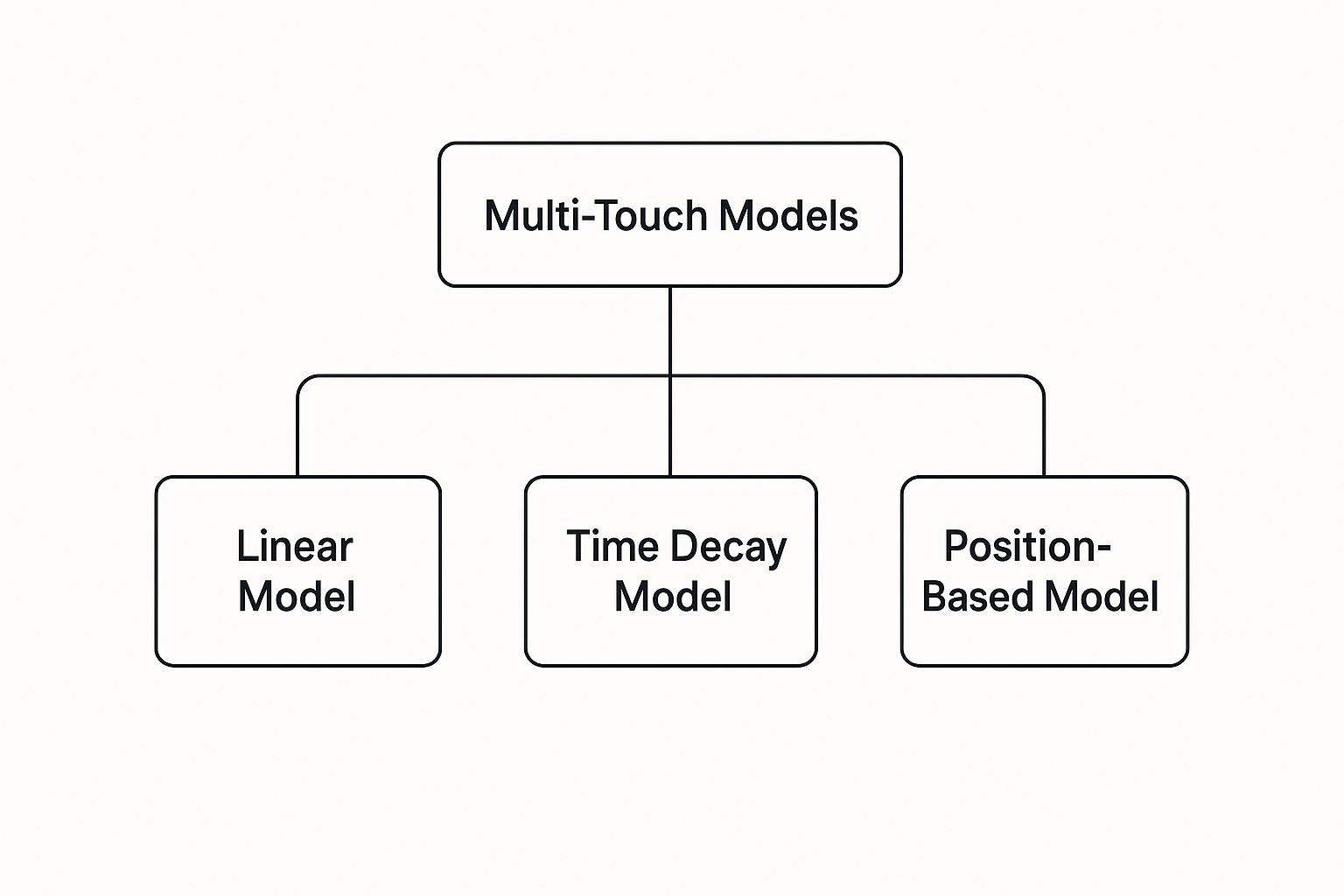
As you can see, each framework prioritizes certain stages of the customer journey, which is why picking the right one is so critical.
Position-Based Models: U-Shaped and W-Shaped
Position-based models are all about giving the most weight to specific milestone touchpoints. The two most common variations are the U-Shaped and W-Shaped models.
The U-Shaped model (also called Position-Based) emphasizes the very beginning and the very end of the journey. It assigns 40% of the credit to the first touch, another 40% to the last touch, and sprinkles the remaining 20% across all the interactions in between.
In our sneaker example, the U-Shaped model would assign credit like this:
- Instagram Ad (First Touch): 40%
- Email & Blog (Middle Touches): 10% each
- Google Search Ad (Last Touch): 40%
The W-Shaped model takes this a step further by introducing a third major milestone: the moment a person becomes a qualified lead (like signing up for a demo).
This model typically assigns 30% credit to the first touch, 30% to the lead-creation touch, and 30% to the final conversion touch. The last 10% gets split among the rest. It’s an ideal fit for B2B companies with very distinct, measurable funnel stages.
Comparing Rule-Based Multi-Touch Attribution Models
Choosing a model isn't just a technical decision; it reflects what you value most in your marketing strategy. Do you care more about what starts the conversation, what closes the deal, or the entire journey? This table breaks down the core rule-based models to help you see the differences at a glance.
| Model | How Credit Is Assigned | Best For | Actionable Insight |
|---|---|---|---|
| Linear | Credit is split equally across all touchpoints. | Long sales cycles and brand awareness campaigns. | Reveals the full path, preventing you from cutting mid-funnel content. |
| Time-Decay | Touchpoints closer to the conversion get more credit. | Short, promotion-driven sales cycles. | Identifies your strongest "closing" channels for quick wins. |
| U-Shaped | 40% to first touch, 40% to last touch, 20% to the middle. | Valuing both lead generation and conversion equally. | Helps you balance budget between top-of-funnel and bottom-of-funnel tactics. |
| W-Shaped | 30% each to first, lead creation, and last touch; 10% to others. | B2B marketing with a clear lead qualification stage. | Shows which channels are best at creating MQLs, not just initial clicks. |
Ultimately, the right model provides actionable insights that align with your business goals. Whether you need to understand top-of-funnel impact or what’s pushing customers over the finish line, there’s a framework that can bring clarity to your data.
Stepping into Data-Driven Attribution

While the rule-based models we've covered bring some much-needed order to the chaos, they all share a fundamental flaw: they're based on our assumptions. You're the one telling the system what's important—the first touch, the last click, or an even split.
But what if you could take the guesswork out of the equation entirely? What if the data itself could tell you which touchpoints were actually doing the heavy lifting?
That’s the promise of data-driven attribution, often called algorithmic attribution. It’s a massive leap forward from fixed rules to intelligent, adaptive measurement. Think of it as the difference between following a static, pre-written script and having a smart assistant that learns and adjusts from every single customer interaction.
Instead of force-fitting your data into a rigid formula, data-driven models use machine learning to analyze the unique, messy, and complex paths your customers take. The algorithm sifts through thousands of journeys—both those that end in a sale and those that don't—to spot the real patterns. It then assigns credit based on the actual, measured impact each channel has on the final decision.
The Algorithmic Advantage
The single biggest benefit here is accuracy. Period. You move beyond educated guesses and get a custom model built specifically around how your customers behave on your site.
This approach is brilliant at uncovering the true value of those middle-of-the-funnel touchpoints—the ones that play a subtle but critical role in nurturing a lead but rarely get the final credit.
By comparing successful conversion paths against unsuccessful ones, a data-driven model can calculate the real probability of a conversion at each step. This allows for a much more nuanced and accurate distribution of credit than any rule-based system could ever hope to achieve.
Getting this right is becoming non-negotiable. The market is shifting toward advanced AI models that can analyze millions of data points to deliver this kind of insight. For companies that get it right, the payoff is huge—often boosting marketing ROI by 25-40%.
What You Need to Make It Work
Data-driven attribution is powerful, but it’s not a magic wand you can wave over a sparse dataset. Its effectiveness is completely dependent on the quality and, more importantly, the volume of data you feed it.
Before you jump in, you need to be honest about a few things:
- Data Volume: To get statistically significant results, you need a lot of data. We're talking thousands of conversions and tens of thousands of unique user paths every single month. Without that, the algorithm is just guessing.
- Technical Chops: A true data-driven model isn't a simple toggle in your analytics tool. It often requires specialized platforms or an in-house team that can manage the complexity.
- Data Hygiene: The model is only as good as the information it’s fed. Clean, consistent tracking across every single channel is an absolute prerequisite. For a deeper dive into the tech behind this, our guide on person-level identification breaks down how individual journeys are tracked.
If your business has lower conversion volumes or you're just starting out, sticking with a solid rule-based model like Linear or U-Shaped is a perfectly smart and practical first step. But for any organization sitting on a mountain of good data, making the move to a data-driven model is like turning on the lights in a dark room.
Your Action Plan for Choosing the Right Model
Alright, let's get out of the textbook and into the real world. Figuring out which attribution model to use isn't some academic exercise—it's about picking the right tool for the job.
The perfect model for a fast-moving e-commerce brand is going to be completely wrong for a B2B SaaS company with a six-month sales cycle. It's that simple.
Making the right call means taking an honest look at your goals, how your customers actually behave, and what resources you have on hand. Let's walk through a few questions to get you pointed in the right direction.
Your Decision-Making Framework
Your business isn't a generic template, so your attribution model shouldn't be either. Think of these questions as a filter to help you match what your business needs with what each model does best.
1. How Long Is Your Sales Cycle?
This is the big one. The time it takes for someone to go from "who are you?" to "take my money" changes everything.
-
Short Sales Cycle (days to weeks): If customers make decisions fast, the touchpoints right before the sale are usually the most important. The Time-Decay model is built for this. It gives more credit to the last few interactions that got the customer across the finish line. Think about a weekend flash sale—you want to know which last-minute email or retargeting ad sealed the deal.
-
Long Sales Cycle (months to a year): When the journey is a marathon, not a sprint, every touchpoint plays a role. The Linear model is your friend here. It gives equal credit to every interaction, making sure you don't accidentally kill the budget for that blog post that introduced a customer to your brand six months before they finally converted. It prevents short-term thinking.
2. What Are Your Primary Business Goals?
What are you actually trying to accomplish right now? Growing your email list? Driving brand awareness?
Your model has to line up with your strategy. If you're all-in on lead generation, a U-Shaped model makes sense—it credits both the first touch (the lead) and the last touch (the conversion). But if you're running a huge brand awareness campaign, a Linear model might be better to value every single impression and click along the way.
3. How Complex Is Your Customer Journey?
Next, map out how many channels and steps are usually involved before someone buys from you.
-
Simple Journey (a few touchpoints): If your path to purchase is pretty direct—say, a social ad straight to a product page—a U-Shaped model is a fantastic place to start. It gives props to what started the journey and what closed it, which is often all the signal you need.
-
Complex Journey (many touchpoints and clear stages): For businesses with a more defined funnel, like most B2B companies, a W-Shaped or Full-Path model is a much better fit. These models let you assign major credit to those key moments in the middle of the funnel, like when a lead becomes marketing-qualified (MQL) or books a demo.
4. What Are Your Available Resources?
Let’s be real about your data and your team's technical skills.
If you have a massive amount of conversion data (thousands per month) and a data science team on standby, then a Data-Driven model is the holy grail. It ditches the guesswork and builds a custom algorithm based on what your actual customers are doing.
But for most businesses, that's overkill. You can get 90% of the value with only 10% of the complexity by starting with a well-chosen, rules-based model. Don't let the hunt for perfection stop you from making solid progress today.
Your Action Plan for Implementation
An attribution model is only as good as its implementation. Moving from theory to practice requires a clear, actionable roadmap. You need to make sure your data is clean, your goals are defined, and your team is on the same page. This plan will get you from initial setup to analyzing your first results.
A successful rollout isn't just a technical task; it's a strategic one. Careful planning is the only way to avoid common pitfalls like incomplete tracking or picking a tool that can't grow with you.
Define Your Key Conversion Events
Before you can track anything, you have to decide what a "win" actually looks like. Is your main goal a completed purchase? A demo request? A newsletter signup?
Be specific and prioritize. A B2B company might map out its key conversion events like this:
- Micro-conversion: Whitepaper download
- Macro-conversion: Demo request submitted
- Sales conversion: Deal closed-won in the CRM
Defining these events ensures your multi-touch attribution models measure what truly matters to the business. You get actionable insights, not just vanity metrics.
Ensure Clean and Comprehensive Data Collection
Your attribution system is completely dependent on the data you feed it. Inaccurate or incomplete data will lead to flawed conclusions, no matter which model you choose. The principle is simple: garbage in, garbage out.
To keep your data clean, focus on two core areas:
- Consistent UTM Tagging: Implement a standardized UTM structure across all your campaigns. This is the only way to accurately track the source, medium, and campaign for every single click, ensuring no touchpoints are miscategorized.
- Robust Tracking Pixels: Double-check that your tracking pixels (like those for Google or Meta) are correctly installed on every relevant page. This is non-negotiable for capturing user interactions and building a complete picture of the customer journey.
Here's an example from Google's documentation showing how a data collection tag is implemented.

This little code snippet is the foundation of your data collection. It has to be implemented correctly for every touchpoint to be captured accurately.
Select the Right Attribution Tool
Choosing the right software is a make-or-break step. The global marketing attribution software market is projected to grow at a CAGR of 13.6% from 2025 to 2030, all because companies need to make sense of fragmented digital journeys. The right tool should fit what you need today while having the horsepower to grow with you tomorrow.
A common mistake is picking a tool that's either too simplistic for your needs or way too complex for your team to manage. Your choice should line up with your data volume, technical resources, and business goals.
Analyze, Iterate, and Get Buy-In
Once your system is live and data is flowing, the real work begins. Your first batch of reports won't be the final word; they're your new baseline for understanding performance. Share these initial findings with other teams—especially sales and IT—to get their buy-in and different perspectives. Collaboration is what makes everyone trust the data.
The insights from your attribution model should directly inform your strategy. You can use this data to fine-tune other marketing processes, too. For instance, you might check out our guide on AI-powered lead scoring to see how attribution data can help you prioritize your most valuable leads. The goal is to create a continuous loop: analyze, act, and improve.
Answering Your Top Attribution Questions
You've got the concepts down, but let's be real—moving to a new way of measuring marketing always brings up some practical questions. We get it. Here are some straight, no-fluff answers to the things marketers usually ask when they're ready to see the whole picture.
What Is the Main Difference Between Single-Touch and Multi-Touch Attribution?
Think of it like a soccer game.
Single-touch attribution is like giving 100% of the credit to the player who scored the final goal. The first-touch model gives it to the first player who touched the ball, and the last-touch model gives it to the final scorer. It’s simple, but you completely miss the assists and defensive plays that made the goal possible.
Multi-touch attribution, on the other hand, is like watching the game replay. It distributes credit across all the players who passed the ball, created the opening, and set up the final shot. You get a far more realistic view of how the entire team—your entire marketing mix—worked together to score.
How Much Data Do I Need for a Data-Driven Attribution Model?
This is a big one. Data-driven models are powerful, but they're also data-hungry. Because they rely on algorithms to find patterns, they need a ton of information to produce anything reliable.
There isn't a perfect magic number, but a good rule of thumb is you'll need thousands of conversions and tens of thousands of individual touchpoints every single month. If you're not at that scale, the model's conclusions can be shaky.
Don't have enterprise-level data volume? No problem. That's exactly why rule-based models like Linear or U-Shaped exist. They offer a huge step up from single-touch and give you actionable insights without needing a massive dataset.
For teams with higher data volumes, our case studies on attribution show just how powerful a data-driven approach can be for uncovering hidden channel value.
Can I Use Multi-Touch Attribution Without an Expensive Tool?
Absolutely. You don't need to jump straight to a pricey, dedicated platform, but be prepared for some manual work.
You can actually start with tools you probably already have. Google Analytics, for instance, has built-in multi-touch reports that let you compare different models right out of the box. It’s a great way to dip your toes in the water.
For a more custom setup, you can export your data to a BI tool and build your own models. The main trade-off is time and effort. Dedicated attribution software automates all the messy data collection and number-crunching, which saves a ton of hours, cuts down on human error, and gets you clearer answers, faster.
Ready to stop guessing and start seeing the full picture of your marketing performance? marketbetter.ai provides an integrated AI platform that simplifies multi-touch attribution, helping you optimize your budget and prove your ROI with confidence. Discover how our platform can transform your marketing analytics.