A Modern Demand Generation Strategy That Works
Let's be honest, the term demand generation strategy gets thrown around a lot. But what does it actually mean in today's market?
It's a full-funnel game plan. The goal is to build awareness and genuine trust with your ideal customers long before they even think about buying something. It’s about becoming the go-to resource in your space, the first name that pops into their head when they have a problem you can solve. You're turning people who barely know you exist into your biggest fans.
What Is Modern Demand Generation?

Forget the old playbook. We're not just collecting a pile of names and email addresses anymore. The modern way to think about demand gen is building a magnetic pull for your brand, establishing your company as the authority people can't ignore.
Compare it to this: A traditional approach is like putting a "For Sale" sign on your lawn, which only captures people already walking by. A modern demand generation strategy is like throwing an incredible block party that draws the entire neighborhood to your front door. One captures existing interest; the other creates new desire. We're building a community and sharing real value first.
Moving Beyond Lead Volume
Not long ago, the game was simple: collect as many leads as possible. Quality didn't matter as much as quantity. That model is broken. Today's buyers are more informed and skeptical than ever, making a volume-first approach ineffective and expensive.
Today, demand generation has grown up. It's an integrated, data-driven strategy that supports the entire buyer’s journey, not just the first touchpoint. We now focus on precision targeting and understanding how customers interact with us across multiple channels before they ever talk to sales. If you want to dive deeper, you can learn more about the evolution of full-funnel success and what it means for your business.
This shift is so important because it speaks to your whole market, not just the tiny 3-5% who are ready to buy right now. By educating prospects and solving their problems with valuable content, you make sure that when their time comes to buy, your brand is the only one they consider.
Actionable Takeaway: A killer demand generation strategy creates a continuous dialogue with your audience. It builds relationships that turn into revenue over the long haul. It's about being consistently helpful and visible, not just showing up when you want to make a sale.
Creating vs. Capturing Demand
Here’s where a lot of teams get it wrong. The real goal of a sophisticated demand gen strategy is to create demand, not just capture what's already out there.
Capturing demand means targeting buyers who are actively searching for a solution (e.g., bidding on keywords like "best CRM for small business"). It’s important, but it's also a crowded, expensive, and limited pool. Creating demand is about engaging the other 95% of your potential market—the ones who aren't looking to buy today but will be your best customers tomorrow (e.g., writing a blog post about "how to improve sales team productivity").
This proactive approach means you’re doing things like:
- Educating the market on problems they might not even realize they have.
- Establishing your brand as a thought leader with genuinely insightful content.
- Nurturing relationships over time without a pushy sales pitch.
When you invest in both creating and capturing demand, you build a resilient pipeline that doesn’t live or die by the small slice of in-market buyers. You're setting the stage for predictable, scalable growth.
Demand Generation vs. Lead Generation
Let's clear the air on something that trips up a lot of marketers: demand generation and lead generation are not the same thing. Not even close.
Treating them as interchangeable is a classic way to burn through your budget and wonder why your pipeline is leaking. Understanding the difference is step one in building a strategy that actually works.
Think of it like hosting a dinner party. Demand generation is everything you do to make people want to come. You're creating buzz, telling stories about how great your cooking is, and making your house sound like the place to be. You're creating the desire.
Lead generation is when you actually send out the invitations and ask for an RSVP. It’s the direct action of capturing the interest you've already built. Both are crucial, but one creates the appetite, and the other collects the names.
Different Goals For Different Funnel Stages
The real split between the two comes down to their goals and where they live in your funnel.
Demand generation is a top-of-funnel play, pure and simple. Its job is to make your ideal customers smarter about the problems they have—problems your product just so happens to solve. It’s about building awareness and establishing your company as a trusted authority, long before anyone is thinking about a sales call.
Lead generation kicks in further down the funnel. This is where you trade value for contact information. You’ve earned their interest with your great content, and now you’re asking them to raise their hand. It's the moment an anonymous visitor becomes a known person by downloading a gated asset or signing up for a demo. This is where an effective chatbot for lead generation can be a powerful tool, instantly engaging interested visitors and converting them into qualified contacts.
The chart below shows why a broad demand generation approach is so important—you have to create awareness across different segments, each with its own needs.
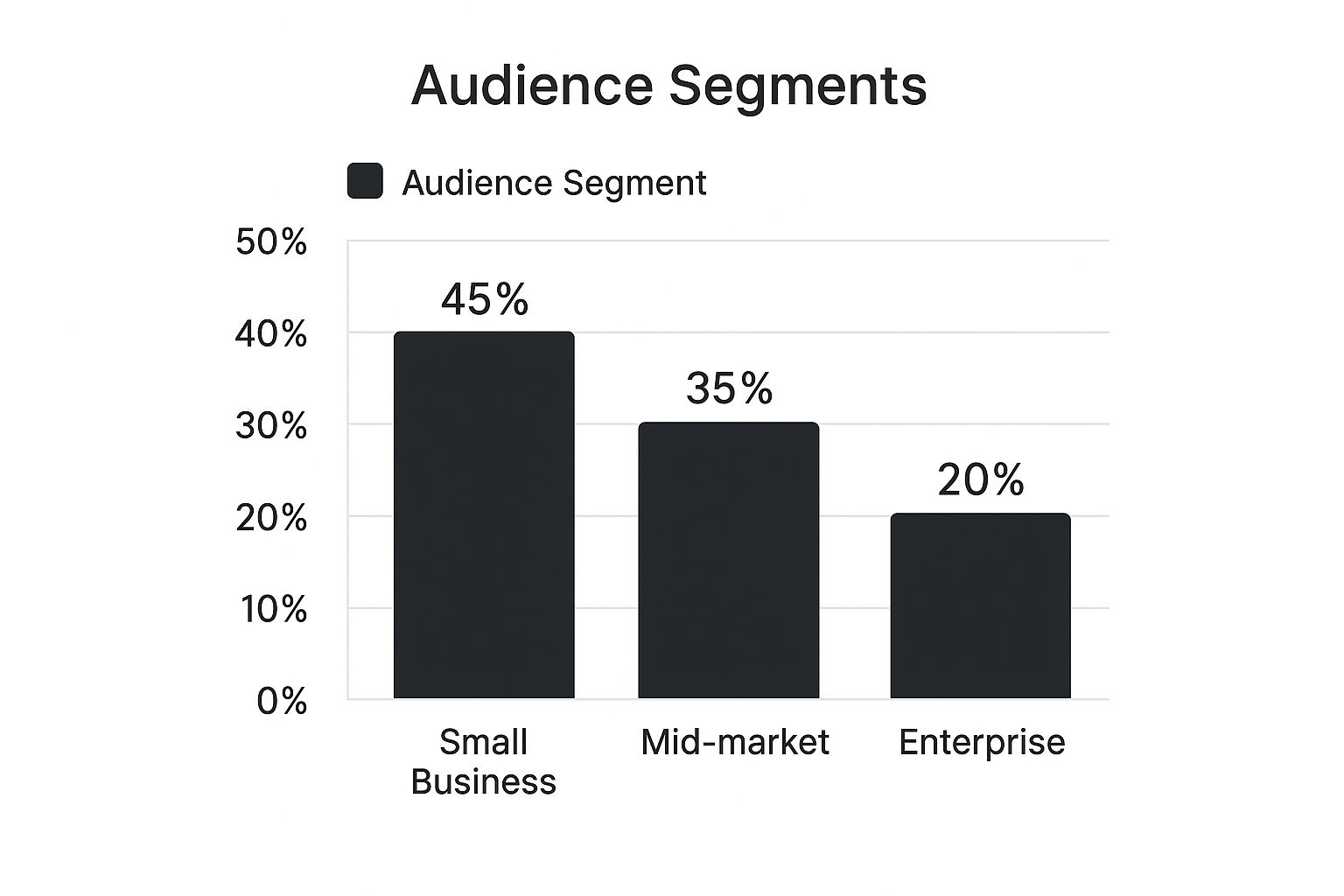
With nearly half the audience in the small business space, you can see how critical it is to produce educational content that builds trust and familiarity from the very beginning.
Demand Generation vs Lead Generation Key Differences
To make this crystal clear, let's put the two side-by-side. The tactics you choose and the numbers you track will be completely different for each.
| Aspect | Demand Generation | Lead Generation |
|---|---|---|
| Primary Goal | Educate the market, build brand awareness, and create a genuine desire for your solution. | Convert interested audience members into identifiable contacts for the sales pipeline. |
| Typical Tactics | Ungated blog posts, podcasts, social media content, educational webinars, original research. | Gated ebooks, checklists, demo requests, consultation forms, free trial sign-ups. |
| Success Metrics | Website traffic, social engagement, video views, brand search volume, share of voice. | Form submission rates, Cost Per Lead (CPL), Marketing Qualified Leads (MQLs). |
This table makes it obvious: you wouldn't judge a podcast (a classic demand gen tactic) on how many MQLs it generated that day. You'd look at downloads, audience growth, and brand mentions.
On the flip side, a "Request a Demo" form (a pure lead gen tactic) is judged almost entirely on its conversion rate. A healthy marketing engine needs both—one to create opportunities and one to capture them.
The Core Components Of A Winning Strategy
A powerful demand generation strategy isn’t a single tactic. It's a machine—a system of interconnected parts all humming in harmony. Just like a car needs an engine, wheels, and a steering system to get you anywhere, your strategy needs distinct but integrated components to actually drive results.
Let's break down the essential pieces you need to assemble a demand gen engine that lasts.
Content Marketing That Educates And Engages
Content is the fuel for your entire demand generation engine. I want to be crystal clear: its job isn’t to sell. Not directly, anyway. Its purpose is to educate, inform, and build trust long before someone is even thinking about buying.
Think of it like this: you want to be the most helpful expert in your field, the one who consistently provides value without asking for anything in return. That simple shift changes the entire dynamic from a sales pitch to a trusted relationship. When prospects see you as a reliable source of answers, who do you think they’ll call when they finally have a problem to solve?
Recent data backs this up. The 2025 Demand Generation Benchmark Survey shows content is still king, with 57% of marketers saying case studies are their top-performing format. It’s all about storytelling and social proof. The survey also found that 29% of teams now have fully integrated brand and demand marketing strategies—a sign that the smartest companies are breaking down old silos. You can dig into the complete survey findings to learn more about the future of demand generation benchmarks.
SEO And Organic Visibility
Here’s the hard truth: great content is completely useless if no one can find it. That’s where Search Engine Optimization (SEO) comes in. It’s the part of the machine that makes sure your valuable insights show up the moment your ideal customers start searching for answers.
SEO for demand generation is different from SEO for lead generation. Lead gen SEO focuses on bottom-funnel, high-intent keywords like "[your product] pricing." Demand gen SEO targets broader, top-of-funnel, problem-aware keywords like "how to improve team productivity" to capture your audience much earlier in their journey.
A smart SEO strategy isn't about gaming the system; it’s about understanding human intent. What questions are your buyers asking Google? When you optimize your content around those real-world queries, you attract high-intent traffic straight to your digital doorstep.
Actionable Tip: Don't just obsess over bottom-funnel keywords. Perform keyword research focused on the problems your ICP faces, not just the solution you sell. Create pillar pages and blog clusters around these problem-based topics to build authority and capture a wider audience.
Account-Based Marketing For Precision Targeting
While content and SEO cast a wide, valuable net, Account-Based Marketing (ABM) is the spear. It's a hyper-focused strategy built to engage a hand-picked list of high-value target accounts. Instead of marketing to everyone, you treat each key account as its own market.
This approach completely flips the traditional marketing funnel on its head. You start by identifying your dream customers, then you build highly personalized campaigns to get the attention of the key decision-makers inside those companies. ABM is all about quality over quantity, making it an incredibly efficient way to spend your time and money, especially for B2B companies with big deal sizes.
ABM vs. Traditional Marketing Comparison
| Aspect | Traditional Marketing | Account-Based Marketing (ABM) |
|---|---|---|
| Audience | Broad, based on personas | Narrow, based on specific accounts |
| Goal | Generate a high volume of leads | Build deep relationships with key stakeholders |
| Tactics | Mass email, broad content, digital ads | Personalized outreach, custom content, direct mail |
| Measurement | Cost Per Lead (CPL), MQLs | Account engagement, pipeline velocity |
The strategic difference is stark. Traditional marketing is a numbers game. ABM is a relationship game, focusing every bit of effort on the accounts most likely to drive serious revenue. For a deeper look at tailoring your message, check out our guide on using AI for content analysis to really nail your account-specific messaging.
Multi-Channel Engagement
Your buyers don't live on a single channel, so your brand can't, either. A winning demand gen strategy delivers a seamless and consistent experience everywhere your audience spends their time—whether that’s LinkedIn, industry forums, podcasts, or their email inbox.
This doesn't mean you have to be everywhere at once. That's a recipe for burnout. It’s about being strategic. Pick the channels most relevant to your Ideal Customer Profile (ICP) and create an integrated presence where your message is cohesive, reinforcing the same value proposition no matter the format.
An effective multi-channel playbook usually includes:
- Social Media: Sharing genuine thought leadership and joining real conversations on platforms like LinkedIn.
- Email Nurturing: Delivering valuable content over time to stay top-of-mind and build a connection.
- Paid Media: Using targeted ads to amplify your best content and reach new, qualified audiences.
- Community Participation: Being an active, helpful voice in the online communities where your ICP hangs out.
When you orchestrate all these components together, you stop running a collection of disconnected tactics and start running a powerful, cohesive demand generation strategy that builds awareness, earns trust, and drives predictable growth.
Using AI And Data For Smarter Targeting
In a crowded market, the best demand generation strategies are powered by intelligence, not just elbow grease. The old “spray and pray” approach is dead and gone. Today, it’s all about using data and AI to connect with the right audience, with the right message, at the exact moment they’re ready to listen.
This shift from manual effort to smart automation is completely changing the game for marketers. Instead of guessing who might be a good fit, we can now use technology to pinpoint in-market buyers with incredible accuracy, all while building solid relationships with future customers.
From Static Lists to Dynamic Targeting
For years, Account-Based Marketing (ABM) ran on static Target Account Lists (TALs). Teams would build a list, and maybe—maybe—revisit it once a quarter. That model just doesn’t work anymore. The market moves way too fast for such a slow, manual process.
Today, AI and modern ABM strategies have transformed demand generation. AI gives marketers the power to use predictive analytics and deliver personalized content, which leads to smarter, data-driven decisions in real-time. ABM has evolved from a clunky, periodic review into a living, breathing system where intent data flows into CRMs and AI scoring models continuously refine the target list.
This visual from My Outreach shows just how much modern demand gen strategies are adapting.
The takeaway is clear: successful strategies are fluid and data-informed, leaving outdated, static planning cycles in the dust.
Predictive Lead Scoring Pinpointing Ready-to-Buy Prospects
One of the most powerful ways to use AI is through predictive lead scoring. Traditional scoring models are okay—they’re usually based on simple demographics and a few actions, like an ebook download. It’s a decent start, but it can often be misleading.
Compare that to predictive models. They churn through thousands of data points—firmographics, technographics, online behavior, and third-party intent data—to find the hidden patterns that actually correlate with a purchase.
Actionable Takeaway: AI cuts through the noise to find the quiet signals that show a prospect is shifting from "just browsing" to "ready to buy." This lets your sales team focus their energy on leads that are actually likely to close, which boosts efficiency and shortens sales cycles in a big way.
This process is a non-negotiable part of a modern demand gen strategy. It ensures you’re aiming your marketing and sales firepower where it will have the most impact. To get a better handle on this, check out our guide on how to implement AI-powered lead scoring for your team.
AI-Driven Personalization at Scale
Personalization is no longer a “nice-to-have.” It’s table stakes. Buyers expect you to deliver content and experiences that speak directly to their needs and headaches. But trying to deliver that kind of customization manually, for thousands of prospects? Impossible.
This is where AI really flexes its muscles.
AI-driven tools can:
- Dynamically change your website content based on a visitor's industry, company size, or past behavior.
- Personalize email nurture campaigns with content recommendations that are genuinely helpful to the person reading them.
- Optimize ad creative on the fly to feature the messaging that hits home with different audience segments.
This level of smart automation ensures you’re always delivering the most relevant message, building a much stronger connection with every single prospect. To really get this right, mastering paid search intelligence is a huge advantage, giving you deep insights into what your audience is actively looking for.
By embracing these technologies, you move from broad-stroke marketing to precision targeting. You stop wasting time and money on the 95% of the market that isn’t ready to buy and instead focus on identifying and engaging the 5% who are—all while intelligently nurturing the rest for the future.
Building Your Actionable Demand Generation Plan

Alright, we’ve covered the theory. But a demand gen strategy only comes to life when you put it on paper and, more importantly, into action. It’s time to shift from the "what" and "why" to the "how"—building the blueprint that will actually drive results.
Think of this plan less as a dusty, 50-page document and more as a living playbook for your team. It’s about turning your big-picture goals into a clear, connected set of steps everyone can get behind.
Step 1: Define Your Ideal Customer Profile
Before you write a single blog post or spend a dollar on ads, you have to know exactly who you're talking to. A vague persona just won’t cut it. You need a razor-sharp Ideal Customer Profile (ICP) that goes way beyond basic demographics.
Your ICP is the compass for every single marketing decision you make. It’s what ensures your messaging lands, your content solves real problems, and you’re not wasting resources on accounts that can’t or won’t buy. Without it, you’re just shouting into the void.
Actionable Steps to Build Your ICP:
- Analyze Your Best Customers: Pull a list of your top 10-20 customers by revenue, satisfaction, and LTV.
- Identify Commonalities: Look for patterns in firmographics (industry, company size, revenue) and technographics (what tech they use).
- Interview Them: Talk to these customers. Ask about their pain points, goals, and buying process. Ask why they chose you over a competitor.
- Synthesize and Document: Create a one-page document that clearly defines your ICP so your entire company is aligned.
Step 2: Map The Buyer's Journey
Once you know your ICP, you need to understand their path from "I have a problem" to "You're the solution." The buyer's journey is never a straight line. It's a winding road filled with questions, research, and multiple touchpoints.
Mapping this out is how you find the moments that matter. It forces you to stop pitching your product and start having a customer-centric conversation, building trust long before anyone asks for a demo.
Actionable Takeaway: A well-mapped journey turns you from an aggressive salesperson into a helpful guide. Create a simple table with three columns: Stage (Awareness, Consideration, Decision), Customer Questions, and Your Content. This forces you to create content that directly answers their questions at each stage.
Step 3: Select The Right Channels And Tactics
With a clear ICP and journey map in hand, you can finally decide where to place your bets. The biggest mistake you can make is trying to be everywhere at once. Focus your demand generation strategy on the channels where your ideal customers are already hanging out.
Let’s look at a couple of common B2B channels to see what this means in practice:
| Channel | Best For | Common Mistake |
|---|---|---|
| B2B thought leadership, connecting with specific job titles, and building a professional community. | Treating it like a digital resume or blasting prospects with aggressive, robotic outreach. | |
| Industry Podcasts | Reaching a super-niche, engaged audience and building deep authority with long-form content. | Obsessing over download numbers instead of the quality and relevance of the audience. |
Your channel strategy should flow directly from your ICP research. If you’re selling to software developers, you’ll probably get more traction on GitHub or Stack Overflow than on Facebook. And for targeted outreach on key platforms, you can even explore things like automating your LinkedIn prospecting to connect with your ICP more efficiently.
Step 4: Create A Content And Measurement Plan
Your content is the fuel for your demand gen engine, and analytics are the dashboard. Every piece of content you create—from a blog post to a webinar—should tie directly back to the pain points you identified in your ICP and buyer's journey. No more content for content's sake.
At the same time, you have to define what success looks like. Ditch the vanity metrics and focus on numbers that show you’re actually impacting the business.
Here are a few key metrics that matter:
- Pipeline Velocity: How fast are deals moving through your funnel? This tells you if you’re actually accelerating sales.
- Customer Acquisition Cost (CAC): How much are you spending in sales and marketing to land one new customer?
- Share of Voice: When people are talking about the problem you solve, how often is your brand part of the conversation?
Following these four steps is how you turn demand generation from an abstract idea into a practical, measurable plan that delivers predictable growth.
How To Measure And Optimize Your Strategy
A demand generation strategy without measurement is just an expensive guess. To build a powerful engine for growth, you need to track what's working, understand why, and make intelligent, data-backed improvements.
This isn't about vanity metrics. It’s about tying every blog post, every ad, and every webinar back to tangible business impact.
Think of it this way: Your strategy is a hypothesis. Your data is the experiment's result. Optimization is using those results to form a better hypothesis for the next cycle.
Moving Beyond Last-Touch Attribution
One of the biggest mistakes marketers make is relying on last-touch attribution. This model gives 100% of the credit for a conversion to the very last thing a prospect did, like clicking a "Request a Demo" ad. It's simple, but it's dangerously misleading.
Compare this to multi-touch attribution. This approach spreads credit across multiple touchpoints in the buyer's journey, revealing the true influence of your top-of-funnel efforts. It’s like giving credit for a goal to the entire team's passes, not just the player who kicked the ball last.
Actionable Takeaway: Implement a multi-touch attribution model (like a U-shaped or W-shaped model in your analytics tool) to see how different channels work together. You might discover that your podcast is the number one source for introducing high-value leads who later convert through a paid search ad. This data justifies your investment in top-of-funnel activities.
Key Metrics To Watch At Every Stage
A healthy demand engine requires a balanced scorecard. You need to track metrics across the entire funnel—from initial awareness to closed deals—to get a complete picture of performance and spot any bottlenecks.
Here’s a practical way to break down your metrics by funnel stage:
| Funnel Stage | Key Metrics | What It Tells You |
|---|---|---|
| Top-of-Funnel | Website Traffic, Social Engagement, Brand Search Volume, Share of Voice. | Are you successfully building awareness and educating your target market? |
| Mid-Funnel | Content Downloads, Webinar Attendance, Email Open/Click Rates. | Are you effectively engaging prospects and nurturing their interest over time? |
| Bottom-of-Funnel | Marketing Qualified Leads (MQLs), Sales Qualified Leads (SQLs), Pipeline Velocity. | Are you creating qualified opportunities that the sales team can actually act on? |
| Revenue Impact | Customer Acquisition Cost (CAC), Customer Lifetime Value (CLV), Marketing-Sourced Revenue. | Is your strategy contributing directly to bottom-line business growth and profitability? |
Creating A Powerful Optimization Loop
Measurement is only half the battle. Optimization is where you turn those insights into action. The goal is a continuous feedback loop where data informs your next move, making your strategy smarter over time.
This boils down to a simple, repeatable process:
- Run Performance Reviews: Schedule bi-weekly or monthly reviews to dive into your key metrics. Look for trends, identify top-performing content and channels, and pinpoint what’s falling flat.
- A/B Test Your Creative: Don't assume you know what works best. Continuously test different headlines, ad copy, images, and calls-to-action to find what resonates most with your audience.
- Gather Sales Feedback: Create a formal process (e.g., a shared Slack channel or a monthly meeting) for your sales team to share insights on lead quality and customer conversations. This qualitative data is priceless.
By consistently measuring and optimizing, your demand generation strategy evolves from a static plan into a dynamic, learning system that gets more efficient and effective with every single campaign.
Got a few questions? Good. Shifting your strategy always brings up some practical stuff. Here are the straight answers to the questions we hear most often.
Inbound vs Outbound Demand Generation
People usually split this into two camps: inbound and outbound. The easiest way to think about it is the difference between a magnet and a megaphone.
-
Inbound demand generation is your magnet. It’s the stuff that pulls people toward you naturally—think killer blog posts, a podcast that actually teaches something, or ranking on Google for a term your buyers search for every day. It’s all about creating valuable, ungated content that attracts people who are already looking for answers. This is how you build trust and become the go-to name in your space.
-
Outbound demand generation is the megaphone. You're proactively pushing your message out to a very specific audience. This could be targeted ads, a sharp cold email sequence, or even old-school direct mail to a list of high-value accounts. It's direct, it's focused, and it works when you know exactly who you need to reach.
A smart strategy doesn't pick a side. It blends them. You use inbound to build a strong foundation of authority for the long haul, and you use outbound to make precise, timely moves when you need to.
How Much Budget Should Go to Demand Generation
There isn't a perfect, one-size-fits-all number. But if you’re just starting, a solid rule of thumb is to allocate 10-20% of your total marketing budget purely to demand creation—the top-of-funnel content that doesn't hide behind a form.
This isn't about gutting your existing budget. It’s about carving out a dedicated slice to build future demand while you keep funding the demand capture tactics (like Google Ads) that are already working for you.
Once you start seeing the results and can connect those early content touches to later pipeline, you can confidently dial that percentage up.
Actionable Takeaway: Start with a 90/10 split between demand capture and demand creation. Track the influence of your creation efforts using multi-touch attribution. As you prove its impact on pipeline, adjust the ratio to 80/20, then 70/30. This data-driven approach allows you to scale what works without taking a huge initial risk.
Ready to build a demand engine that drives predictable growth? marketbetter.ai uses an integrated AI approach across content, campaigns, and engagement to help you connect with your ideal customers. Optimize your marketing strategy today.