10 Actionable Marketing Personalization Strategies for 2025
In a hyper-competitive market, generic messaging no longer cuts it. Customers don't just appreciate personalized interactions; they expect brands to understand their unique needs, preferences, and immediate context. The days of simply inserting a first name into an email template are over. True connection is built on a foundation of sophisticated, data-driven engagement, which is where effective marketing personalization strategies become indispensable.
This article moves beyond the basics to provide a comprehensive roundup of ten powerful and actionable tactics that create genuinely unique customer experiences. We will dissect each strategy, comparing its strengths and ideal use cases to help you build a more effective marketing engine. For those seeking a foundational understanding before diving into advanced tactics, you can read more about what is personalization in marketing to get up to speed.
From harnessing real-time behavioral data to leveraging predictive analytics, you will learn how to implement these approaches with practical, step-by-step guidance. Each item in this list includes actionable implementation tips and real-world examples to illustrate how to turn theory into practice. By mastering these diverse strategies, you can forge deeper customer relationships, significantly boost loyalty, and drive measurable ROI. We will explore everything from dynamic content optimization and purchase history-based recommendations to advanced AI-driven personalization, equipping you with the tools needed to deliver the right message to the right person at the perfect moment. Let’s explore how to build a personalization framework that not only meets customer expectations but consistently exceeds them.
1. Behavioral Personalization
Behavioral personalization is one of the most powerful marketing personalization strategies, focusing on what users do rather than just who they are. This approach leverages real-time and historical user behavior data, such as browsing history, purchase patterns, time spent on pages, and click-through rates, to customize marketing messages and website experiences. Instead of relying on static demographic profiles, it dynamically adapts to a user's journey, predicting their needs and delivering relevant content at the precise moment it matters most.

This method stands in contrast to demographic personalization, which groups users by attributes like age or location. While demographics provide a good starting point, behavioral data reveals intent. For example, knowing a user is a 35-year-old male is less useful than knowing he has viewed three different hiking boots in the last hour. Giants like Amazon pioneered this with its "Customers who bought this also bought" recommendations, while Netflix's content suggestions are a masterclass in using viewing history to keep users engaged.
Actionable Implementation Tips
To effectively implement this strategy, start with foundational data points and build from there. Focus on high-intent actions first to maximize your initial impact and ROI.
- Start with Core Behaviors: Begin by tracking fundamental interactions like specific page views, items added to a cart, and past purchases. Use this data to trigger simple yet effective campaigns, such as abandoned cart emails or product recommendations based on a recently viewed category.
- Implement Behavioral Triggers: Set up automated workflows based on specific actions. For instance, if a user downloads a whitepaper on a particular topic, trigger an email sequence offering a related webinar or case study. Actionable Step: Create a "Top 3" list of your highest-value behaviors (e.g., viewing the pricing page, watching a demo video, adding an item to cart) and build your first automated trigger for the most common one.
- Combine with Other Data: Enhance behavioral insights by layering them with demographic or contextual data. Knowing a user repeatedly views winter coats and that their local weather forecast predicts a cold snap allows you to send a highly timely and relevant promotion.
Key Insight: The goal of behavioral personalization is to create a fluid, responsive experience that feels less like marketing and more like a helpful conversation. It’s about anticipating the next step in the customer's journey and proactively guiding them.
To execute this effectively, you must have a clear understanding of your audience segments and the data signals that define them. This often requires sophisticated tools capable of person-level identification and data analysis to connect actions across different sessions and devices.
2. Demographic Segmentation
Demographic segmentation is one of the most foundational marketing personalization strategies, involving the division of a market into segments based on variables like age, gender, income, location, education, and occupation. This approach operates on the principle that consumers with shared demographic traits are likely to have similar purchasing habits and preferences. It provides a clear, data-driven framework for creating messages that resonate with specific groups, making it an essential starting point for any personalization effort.
This method contrasts with psychographic segmentation, which focuses on lifestyle and personality traits. While demographics tell you who the customer is, psychographics explain why they buy. For example, a campaign for a luxury car might target high-income individuals (demographic), but it succeeds by appealing to their desire for status or performance (psychographic). Demographics are simpler to implement but offer less nuance. Companies like Nike master this by offering age-specific product lines for kids, teens, and adults, while L'Oréal tailors its beauty campaigns to different age groups' distinct skincare needs.
Actionable Implementation Tips
To move beyond basic demographic targeting, you must enrich this data with other insights. Use demographics as a scaffold, not a silo, to build a more nuanced understanding of your audience.
- Combine with Other Data Types: Enhance demographic profiles by layering them with behavioral or transactional data. Knowing a customer is a 25-year-old female living in a city is useful, but knowing she recently purchased running shoes and browses for marathon gear allows for hyper-relevant product recommendations.
- Regularly Update and Validate: Demographics are not static; people’s incomes change, they move, and their family structures evolve. Use surveys, preference centers, and third-party data enrichment tools to keep your audience information current and avoid marketing based on outdated assumptions. Actionable Step: Add a "Update Your Profile" link to your email footer that leads to a simple preference center where users can self-select interests or update their job title.
- Test Assumptions Across Segments: Do not assume that all individuals within a demographic segment behave identically. Use A/B testing to validate your hypotheses. For instance, test different messaging or offers on a "30-35 year old, high-income" segment to discover which approach truly drives conversions.
Key Insight: Demographic data provides the fundamental "who" but is most powerful when used to answer "what next?" It is the essential first layer upon which more sophisticated personalization, such as behavioral or contextual strategies, can be built for maximum impact.
Executing this well means treating demographic segmentation not as the final goal, but as a critical first step in developing more advanced marketing personalization strategies. It offers a scalable and efficient way to create initial relevance before diving into more granular, individualized tactics.
3. Dynamic Content Optimization
Dynamic content optimization is a sophisticated marketing personalization strategy where website elements, emails, and ads automatically change in real-time based on user data. This approach moves beyond static messaging by tailoring specific components like headlines, images, offers, and calls-to-action for each individual visitor. The goal is to create a uniquely relevant experience that maximizes engagement and conversion by presenting the most compelling content at any given moment.
Unlike A/B testing, which tests variations on a broad audience to find a single "winner," dynamic content delivers the best-performing variation to specific audience segments simultaneously. The key difference is automation and scale: A/B testing is a manual experiment, while dynamic content is an ongoing, automated process. For instance, HubSpot’s "Smart Content" allows marketers to show different website banners to first-time visitors versus qualified leads. Similarly, Booking.com uses this to display personalized travel deals based on a user's search history and location, creating a sense of urgency and relevance that drives immediate action. For real-world applications of personalization in action, explore these effective personalized landing page examples.
Actionable Implementation Tips
To succeed with dynamic content, start small and scale your efforts as you gather more data and insights. A phased approach prevents complexity and ensures each change is impactful.
- Start with High-Impact Elements: Begin by customizing simple yet powerful components like website headlines or hero images. For example, change the headline to reflect the user's industry or the call-to-action to align with their lifecycle stage (e.g., "Request a Demo" for a lead versus "Contact Support" for a customer).
- Create a Comprehensive Content Library: Develop a repository of content variations (images, copy, offers) for each key audience segment. This ensures your system has a rich set of options to choose from, preventing repetitive experiences and enabling more granular personalization. Actionable Step: For your homepage hero image, create three variations: one for new visitors, one for leads from the finance industry, and one for existing customers. Implement a rule to show the right one based on visitor data.
- Use Machine Learning to Optimize: Leverage AI-powered tools like Adobe Target or Optimizely to automate the selection process. These platforms can analyze user behavior in real-time to predict which content combination is most likely to convert, continuously improving performance without manual oversight.
Key Insight: Dynamic content optimization transforms a one-size-fits-all digital property into a collection of millions of potential versions, each one fine-tuned to resonate with a specific user's context, behavior, and needs.
This strategy requires a robust technology stack and a clear understanding of your audience segments. When implemented correctly, it serves as a powerful engine for improving relevance and driving significant lifts in key marketing KPIs.
4. Purchase History-Based Recommendations
Purchase history-based recommendations are a cornerstone of effective marketing personalization strategies, using past buying behavior to forecast future needs. This approach analyzes what customers have previously bought to suggest relevant products, driving repeat business and enhancing loyalty. Unlike behavioral personalization which often includes browsing actions, this method is rooted in completed transactions—a much stronger signal of a customer's preferences and budget. It leverages data to create a curated shopping experience that feels uniquely tailored to each individual.
This strategy was famously pioneered and perfected by companies like Amazon, whose recommendation engine is responsible for an estimated 35% of its revenue. It's also the engine behind Sephora’s Beauty Insider suggestions and Starbucks' personalized mobile app offers. By analyzing purchase data, brands can move beyond generic promotions and offer items that customers are highly likely to value, significantly boosting cross-sell and upsell opportunities.
The following infographic highlights the immense impact of recommendation engines on revenue and engagement.
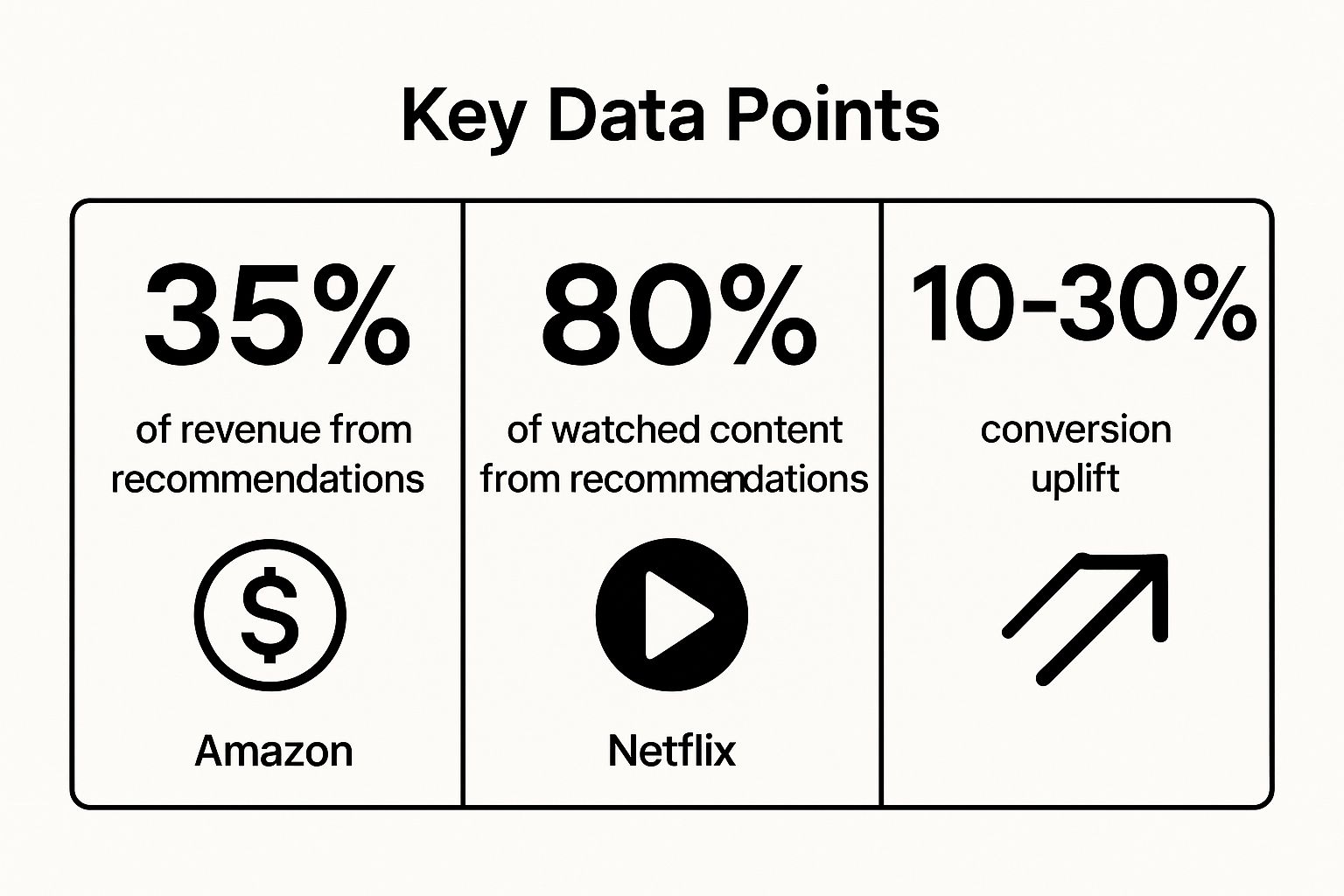
These figures demonstrate that recommendations are not just a minor feature but a central driver of business growth, directly influencing conversion rates and customer retention.
Actionable Implementation Tips
To effectively leverage purchase history, focus on combining data streams and refining the timing and logic of your recommendations for maximum impact.
- Combine with Browsing Behavior: Enhance accuracy by integrating purchase history with recent browsing data. A customer who bought hiking boots last year and is now browsing for tents is a prime candidate for a "Complete Your Camping Gear" campaign. This hybrid approach provides a more complete view of their current intent.
- Use Purchase Frequency to Time Offers: Analyze how often customers re-purchase certain items. If a customer buys a 30-day supply of coffee every month, send a reminder or a subscription offer around day 25. This proactive timing makes the message helpful rather than intrusive. Actionable Step: Identify your top 5 consumable products. Calculate the average re-purchase cycle for each and set up an automated email reminder that triggers 7 days before the cycle ends.
- A/B Test Recommendation Algorithms: Don't rely on a single recommendation model. Test different approaches, such as "customers who bought this also bought" (collaborative filtering) versus "products similar to this one" (content-based filtering), to see which one performs best for different product categories and customer segments.
Key Insight: This strategy transforms a simple transaction record into a predictive tool. The goal is to make customers feel understood by showing them you remember their past choices and can help them discover their next favorite product.
5. Email Personalization and Automation
Email personalization and automation are cornerstones of modern marketing personalization strategies, moving far beyond simply inserting a subscriber's first name. This approach tailors email campaigns to individual user data, behavior, and lifecycle stage. It leverages automation to deliver highly relevant content, such as personalized product recommendations, dynamic content blocks, and behavior-triggered messages, creating a one-to-one dialogue at scale.
This strategy differs from generic email blasts by treating the inbox as a personal space for conversation. A key comparison is with social media personalization: email is a direct, permission-based channel, allowing for deeper, more sequential storytelling, whereas social is better for discovery and broad interest targeting. Grammarly excels at this with its weekly writing insight reports, while Airbnb sends location-based travel suggestions that feel curated for the individual. The goal is to make every email feel anticipated, relevant, and valuable.
Actionable Implementation Tips
To implement this effectively, focus on segmenting your audience and automating workflows based on meaningful triggers. Start small and build complexity as you gather more data.
- Segment Beyond Demographics: Group subscribers based on engagement levels (active, inactive), purchase history, and stated preferences. Create tailored campaigns for each segment, such as a re-engagement series for dormant users or exclusive offers for VIP customers.
- Implement Trigger-Based Workflows: Set up automated email sequences for key actions like welcome series for new subscribers, abandoned cart reminders, and post-purchase follow-ups. Actionable Step: Build a 3-part abandoned cart sequence. Email 1 (1 hour later): "Did you forget something?" Email 2 (24 hours later): "Your items are selling fast." Email 3 (48 hours later): "Here's a 10% discount to complete your order."
- Personalize Content Dynamically: Use dynamic content blocks within your email templates to show different offers, articles, or products based on a subscriber's data. For example, an e-commerce store can display items related to a user's last viewed category, making the content highly specific to their interests.
Key Insight: Effective email personalization isn't about mastering one tactic; it’s about creating an integrated system where subscriber data continuously refines automated communication. The result is an email experience that builds loyalty and drives action because it consistently provides value.
Executing this requires a platform capable of deep segmentation and robust automation. By leveraging advanced tools, you can explore new features for email personalization to unlock a deeper level of customer connection and engagement.
6. Geographic and Location-Based Targeting
Geographic and location-based targeting is one of the most contextually relevant marketing personalization strategies, leveraging a user's physical location to deliver timely and specific messages. This approach uses data from IP addresses, GPS signals from mobile devices, or user-provided information to tailor content, promotions, and experiences. By understanding where a customer is, you can serve them information that is immediately useful, from promoting local store events to adjusting offers based on regional weather.
This method moves beyond broad national campaigns to create a sense of local presence and relevance. While demographic targeting might tell you a customer's city, location-based targeting can tell you if they are currently walking past your store. This real-time component makes it more dynamic and actionable than static demographic data. For example, Starbucks uses its app to show users the nearest store and push local promotions, while REI sends emails recommending rain gear to customers in areas where a storm is forecast.
Actionable Implementation Tips
To implement this strategy successfully, focus on transparency and delivering genuine value in exchange for location data. Start with broad geo-targeting and then refine your approach with more granular, real-time tactics.
- Create Location-Specific Landing Pages: Instead of a generic homepage, direct traffic from different regions to landing pages featuring local testimonials, store information, or region-specific offers. This simple step can significantly improve conversion rates by making the content more relatable.
- Use Local Events and Culture in Messaging: Incorporate local holidays, sporting events, or cultural nuances into your campaigns. For example, a restaurant chain could run a special promotion in a specific city when the local sports team has a home game, connecting with the community on a personal level.
- Implement Geo-fencing and Geo-conquesting: Set up virtual perimeters around specific locations (geo-fencing), like your own stores, to trigger push notifications with offers when a user enters. Actionable Step: To try geo-conquesting, set up a geo-fence around your top competitor's location and run a mobile ad campaign offering a 15% discount to users within that zone.
Key Insight: Geographic personalization is most powerful when it bridges the digital and physical worlds. The goal is to make your brand a convenient and relevant part of the customer's immediate environment, providing utility at the exact moment of need.
Executing this requires a platform capable of processing real-time location signals and integrating them with your marketing automation tools. Always be transparent about requesting location access and clearly state the benefit to the user, as trust is paramount for this highly personal data.
7. Predictive Analytics and AI-Driven Personalization
Predictive analytics and AI-driven personalization represent the frontier of marketing personalization strategies, using machine learning to forecast future customer behavior. This advanced approach moves beyond reacting to past actions and instead anticipates future needs, preferences, and potential churn. By analyzing vast datasets, AI algorithms identify subtle patterns and correlations that are impossible for humans to detect, enabling businesses to proactively deliver hyper-relevant experiences.
This method is a significant evolution from rules-based personalization, which relies on predefined "if-then" logic (e.g., "if user views page X, then show offer Y"). While effective, rules-based systems are static and can't adapt without manual intervention. AI, in contrast, learns and optimizes automatically, making it infinitely more scalable and precise. Netflix's recommendation engine doesn't just show you movies similar to what you've watched; it predicts what you'll be in the mood for next. Similarly, Salesforce Einstein can predict which sales leads are most likely to convert.
Actionable Implementation Tips
Adopting AI requires a strategic approach that balances technological power with practical business goals. Start with manageable projects that deliver clear value before scaling to more complex applications.
- Start with Pre-Built AI Tools: Before investing in custom-built models, leverage the predictive capabilities within your existing marketing automation or CRM platforms. Tools like Salesforce Einstein or HubSpot's predictive lead scoring offer a lower barrier to entry and can provide immediate insights.
- Ensure Data Quality and Consistency: AI models are only as good as the data they are trained on. Prioritize cleaning and unifying your customer data across all touchpoints. Actionable Step: Perform a data audit. Identify your top 3 sources of customer data (e.g., CRM, website analytics, purchase history) and create a plan to merge them into a single, consistent customer profile.
- Implement Gradual Rollouts: Test your predictive models on smaller segments of your audience first. Monitor performance closely, comparing the AI-driven segment against a control group to measure uplift in engagement, conversion, and retention before a full-scale deployment.
Key Insight: The true power of predictive personalization lies in its ability to move from reactive marketing to proactive relationship-building. It allows you to solve a customer's next problem, often before they've even articulated it.
Successfully executing this strategy requires a commitment to data hygiene and a willingness to trust algorithmic insights. While maintaining human oversight is crucial, embracing AI allows marketing teams to automate complex decisions and scale personalization to a level that was previously unimaginable.
8. Lifecycle Stage Personalization
Lifecycle stage personalization is a strategic approach that tailors marketing based on a customer's evolving relationship with your brand. This method moves beyond single interactions to consider the entire customer journey, from a visitor's first touchpoint to their transformation into a loyal advocate. It acknowledges that a new prospect needs different information and messaging than a long-time, high-value customer. By aligning communication with their current stage, you create a more logical and supportive experience.
Unlike behavioral personalization, which often focuses on micro-actions (e.g., clicks, page views), lifecycle marketing looks at the macro-level journey. This makes it more strategic and relationship-focused. While a behavioral trigger might send an email about a specific abandoned cart, lifecycle personalization would identify the user as being in the "consideration" stage and nurture them with case studies, comparison guides, and trial offers. Platforms like HubSpot and Salesforce have popularized this by building powerful automation tools that allow marketers to guide leads from awareness to purchase and beyond.
Actionable Implementation Tips
To implement this strategy effectively, you must first define what each stage means for your business and then create targeted content that facilitates progression to the next.
- Map Your Customer Journey: Clearly define the stages in your customer lifecycle (e.g., Subscriber, Lead, Marketing Qualified Lead, Customer, Advocate). Establish specific criteria and data points that automatically move a contact from one stage to the next.
- Create Stage-Specific Content: Develop a library of content tailored to the needs of each stage. A "Lead" might receive an educational ebook, while a "Customer" gets an advanced user guide or an invitation to a loyalty program. Actionable Step: Create one high-value content asset for each defined stage. For 'Leads,' an industry report. For 'MQLs,' a detailed case study. For 'Customers,' a VIP webinar.
- Monitor Stage Progression Rates: Analyze how quickly contacts move between stages and identify bottlenecks. If many leads are stuck in the "Marketing Qualified Lead" stage, you may need to adjust your sales handoff process or provide more bottom-of-funnel content to encourage conversion.
Key Insight: This strategy’s power lies in its long-term vision. It transforms marketing from a series of disjointed campaigns into a single, cohesive journey that builds trust and maximizes customer lifetime value.
Implementing lifecycle stage personalization requires a robust CRM or marketing automation platform capable of tracking user progression. By understanding and catering to the specific needs of each stage, you can orchestrate more meaningful and profitable customer relationships.
9. Social Media and Interest-Based Personalization
Social media and interest-based personalization is a powerful strategy that taps into the rich data users willingly share on social platforms. This approach focuses on a user's expressed interests, such as the accounts they follow, the content they engage with, and the topics they discuss, to build a detailed profile of their preferences. By leveraging this data, marketers can deliver highly relevant ads, content, and product suggestions directly within social feeds and across other channels.
This method moves beyond simple demographics by capturing an individual's passions and affinities. Compared to purchase history, which reflects past needs, social data often reveals aspirational wants and community identity. Knowing a user follows several rock-climbing brands and influencers on Instagram is far more predictive for future gear sales than knowing their age and location. Platforms like Facebook and TikTok have built their entire advertising models on this principle, using sophisticated algorithms to match content with users most likely to find it engaging.
Actionable Implementation Tips
To implement this strategy effectively, you must connect social insights with your broader marketing efforts. The goal is to create a seamless experience that reflects a user's known interests.
- Use Social Listening Tools: Deploy tools to monitor conversations, hashtags, and trends related to your industry. This helps you identify emerging interests and create customer segments based on real-time discussions, allowing for more agile and relevant campaigns.
- Create Interest-Based Segments: Go beyond platform-level targeting. Use data from social logins or user-provided profiles to build segments in your CRM or marketing automation platform. Actionable Step: Run a poll on Instagram Stories asking followers to vote on their favorite product feature. Use the results to create two new ad audiences: one targeting users who voted for Feature A, and another for Feature B, each with tailored messaging.
- Engage Authentically, Don't Just Advertise: Personalization here isn't just about showing a targeted ad. It's about participating in the conversation. Engage with users who mention relevant interests, share user-generated content, and create content that genuinely adds value to their passions.
Key Insight: The power of social media personalization lies in its ability to target based on passion and identity, not just need. It allows brands to connect with customers on a cultural and emotional level, fostering loyalty that transcends transactional relationships.
Executing this requires a unified view of the customer, combining social data with other signals like email engagement. For example, you can enhance your outreach by incorporating personalized videos into your email sequences, which is particularly effective for audiences cultivated through visual platforms. You can explore a variety of engagement tactics by reviewing different approaches to video and email automation.
10. Real-Time Personalization and Contextual Marketing
Real-Time Personalization and Contextual Marketing represents one of the most advanced and responsive marketing personalization strategies. It focuses on adapting the customer experience in the moment based on immediate context, including current behavior, time of day, location, device, and even environmental factors like the weather. This approach goes beyond historical data to leverage what a user is doing right now, enabling brands to deliver hyper-relevant messages with millisecond precision.
While behavioral personalization uses past actions to predict future intent, contextual marketing reacts to the present. It's the difference between a planned conversation and a spontaneous, perfectly timed interjection. For example, knowing a user has previously bought running shoes is behavioral; noticing they are browsing for rain-proof running gear on their mobile phone while it's raining in their city is contextual. Tech giants like Amazon use this for dynamic pricing, while Spotify suggests playlists based on the time of day or a user's current activity.
Actionable Implementation Tips
Implementing real-time personalization requires a sophisticated tech stack and a clear focus on high-impact scenarios. Start small and scale your efforts as you prove the ROI.
- Start with High-Value Touchpoints: Don't try to personalize everything at once. Focus on critical moments in the customer journey, such as the homepage for a first-time visitor, the checkout process for a returning customer, or a pricing page for a user showing high purchase intent.
- Focus on Contexts That Matter: Identify contextual signals that genuinely add value. A travel site could use a visitor's location to highlight nearby getaways, or a food delivery app could promote warm soups and indoor dining options during a cold, rainy day. Actionable Step: Implement a simple real-time rule on your website. If a user visits from a mobile device between 12 PM and 2 PM local time, display a banner that says "Quick Lunchtime Read? Check Out Our Latest Guide."
- Implement Robust Fallback Systems: Real-time systems can be complex. Ensure you have default experiences or non-personalized fallbacks ready to go if the technology fails or data is unavailable. This prevents a broken user experience and protects your brand reputation.
Key Insight: The power of real-time personalization lies in its ability to make marketing invisible and seamlessly integrated into the user's immediate reality. When done right, it feels less like a promotion and more like a genuinely helpful, intuitive service.
Executing this strategy effectively requires technology capable of processing vast amounts of data instantly. Platforms like Salesforce Interaction Studio and Adobe's Real-Time CDP are designed for this, enabling brands to listen to and react to customer signals as they happen.
Marketing Personalization Strategies Comparison
| Personalization Strategy | Implementation Complexity 🔄 | Resource Requirements ⚡ | Expected Outcomes 📊 | Ideal Use Cases 💡 | Key Advantages ⭐ |
|---|---|---|---|---|---|
| Behavioral Personalization | High - requires real-time tracking and analysis | Advanced tracking infrastructure, data scientists | 10-30% conversion uplift, real-time optimization | Behavioral targeting, cross-channel personalization | Accurate, scalable, real-time optimization |
| Demographic Segmentation | Low - straightforward segment definitions | Readily available demographic data | Broad market segmentation, initial profiling | Initial market segmentation, traditional media planning | Easy, cost-effective, broad applicability |
| Dynamic Content Optimization | High - needs robust CMS, A/B testing tools | Content libraries, CMS integration, analytics | Improved engagement, reduced content costs | Websites, emails, ads with dynamic content | Automated content, continuous optimization |
| Purchase History-Based Recommendations | Medium - moderate complexity with filtering | Purchase data, recommendation algorithms | 10-30% conversion uplift, increased order value | Repeat purchase, upsell/cross-sell campaigns | High ROI, loyalty building, decision support |
| Email Personalization and Automation | Medium to High - requires automation setup | Clean segmented lists, automation platforms | 6x higher transactions, 14%+ open rates | Lifecycle-based email campaigns, lead nurturing | Scalable, cost-effective, automated nurturing |
| Geographic and Location-Based Targeting | Medium - requires location tech & content creation | GPS/IP data, geo-fencing, localized content | Increased foot traffic, local marketing impact | Mobile marketing, local promotions | Highly relevant for mobile, local targeting |
| Predictive Analytics & AI-Driven | Very High - needs ML expertise and infrastructure | AI/ML platforms, data scientists, large datasets | Proactive personalization, improved accuracy | Advanced customer behavior prediction, churn prevention | Scalable, reveals hidden insights |
| Lifecycle Stage Personalization | High - requires detailed journey mapping | Tracking systems, automation workflows | Improved conversion & retention by stage | Customer journey marketing, nurture sequences | Personalized stage-based messaging |
| Social Media and Interest-Based | Medium - depends on platform integrations | Social APIs, social listening tools | High social engagement, viral content potential | Social campaigns, interest targeting | Rich data, real-time insights, engagement |
| Real-Time Personalization & Contextual | Very High - complex, real-time data and tech | Real-time processing, in-memory DBs, ML engines | Highest relevance & conversion, superior CX | Instant context-based marketing, dynamic pricing | Maximum timeliness, competitive edge |
Your Next Move: From Personalization Strategy to Scalable Reality
Embarking on a journey to master marketing personalization strategies can feel like assembling a complex puzzle. You have all the pieces explored in this guide-behavioral triggers, demographic data, dynamic content, predictive AI, and more. The challenge isn't merely knowing what these pieces are; it's understanding how they fit together to create a cohesive, compelling, and consistent customer experience that drives tangible business results. Moving from theory to practice requires a strategic, phased approach, not an overnight overhaul.
The core takeaway is that personalization is not a single tactic but a multifaceted philosophy. It's about shifting your entire marketing paradigm from broadcasting a one-size-fits-all message to engineering a one-to-one dialogue. This means recognizing that a first-time visitor, intrigued by a blog post (Lifecycle Stage Personalization), requires a fundamentally different interaction than a loyal customer who has made multiple purchases (Purchase History-Based Recommendations). Your goal is to build an intelligent system where these strategies work in concert.
From Foundational to Futuristic: Creating Your Implementation Roadmap
To make this transition manageable, think of your personalization efforts in progressive layers. Don't try to implement predictive AI on day one if you haven't yet mastered basic email segmentation. A practical roadmap is crucial for building momentum and demonstrating value at each stage.
-
Phase 1: The Foundational Layer (Start Here)
- Focus On: Combine Demographic Segmentation with Lifecycle Stage Personalization. This is your low-hanging fruit. Start by creating distinct communication paths for new leads, marketing-qualified leads (MQLs), sales-qualified leads (SQLs), and existing customers.
- Actionable Step: Map out the key touchpoints for each lifecycle stage. For a new lead, the goal might be education, using their provided job title (demographic) to tailor a welcome email series. For an SQL, the goal is conversion, perhaps triggering a personalized case study relevant to their industry.
-
Phase 2: The Responsive Layer (Build Momentum)
- Focus On: Integrate Behavioral Personalization and Dynamic Content Optimization. Now, you move from static attributes to dynamic actions. What pages did they visit? What content did they download? Use this data to change website banners, CTAs, and email content in real-time.
- Actionable Step: Set up three key behavioral triggers. For example: if a user visits your pricing page twice but doesn't convert, send them an automated email addressing common pricing questions. If they download an ebook on a specific topic, dynamically feature related blog posts on your homepage during their next visit.
-
Phase 3: The Predictive Layer (Achieve Scale)
- Focus On: This is where you leverage Predictive Analytics and AI-Driven Personalization. Instead of just reacting to past behavior, you begin to anticipate future needs. This layer analyzes vast datasets to predict churn risk, identify high-value leads, and recommend the "next best action" for your sales and marketing teams.
- Actionable Step: Implement a lead scoring model that uses predictive indicators, not just explicit actions. An AI model can analyze thousands of data points-from company size and tech stack to subtle website engagement patterns-to surface the leads that are most likely to close, allowing your team to prioritize their efforts effectively.
The Ultimate Goal: An Integrated, Human-Centric Experience
As you advance through these phases, you will see that the most effective marketing personalization strategies are not isolated tactics but interconnected systems. A customer's geographic location might influence the real-time offers they see, while their social media interests inform the ad creative they are served. The end game is to create an omnichannel experience so seamless and relevant that the customer doesn't even "see" the personalization; they just feel understood.
This journey transforms your marketing from a series of disjointed campaigns into a continuous, evolving conversation. It empowers your sales teams with unparalleled context, enabling them to engage prospects with hyper-relevant insights. It builds brand loyalty not through discounts, but through genuine value and a deep understanding of the customer's needs. Mastering these strategies is no longer a competitive advantage-it's a fundamental requirement for growth in a crowded digital landscape.
Ready to unify your data and turn these sophisticated marketing personalization strategies into an automated reality? marketbetter.ai provides the AI-powered engine B2B teams need to analyze customer behavior, dynamically personalize content across channels, and scale one-to-one conversations. Explore how our platform can help you build your roadmap to personalization maturity at marketbetter.ai.