How to Use AI in Marketing: An Actionable Guide
When people talk about using AI in marketing, it's not about letting robots take over. It's about automating repetitive tasks, personalizing experiences for your audience at a scale you could never manage manually, and using data to make much smarter decisions.
It really boils down to three actionable pillars: generating content with AI tools, automating campaign workflows, and using predictive analytics to optimize what's working.
The New Era of AI-Powered Marketing

We're in the middle of a massive shift in how businesses connect with people. Artificial intelligence isn’t some far-off concept anymore; it's a practical, powerful tool sitting right in our marketing toolkits. The key is to move past the hype and figure out how these tools can help us work smarter, not just harder.
The real magic of AI in marketing is its ability to process enormous amounts of data and execute tasks with a speed and precision humans just can't match. This is what lets you create deeply personal customer journeys, whip up high-converting ad copy in seconds, and even predict which customers might be getting ready to leave.
This isn't just a fleeting trend—it's a full-blown market transformation. The AI marketing space shot up from around $12.05 billion in 2020 to a staggering $47.32 billion by 2025. And it’s not slowing down. Projections show the market swelling to over $107.5 billion by 2028, a clear sign that this is a permanent change in our industry. You can discover more insights about AI marketing growth on seo.com.
From Manual Effort to Intelligent Automation
The biggest win from bringing AI into your workflow is automating all those tedious, time-sucking tasks. This frees up your team to actually focus on strategy and creativity. Instead of spending hours buried in spreadsheets or manually A/B testing email subject lines, an AI can knock it out in minutes.
But it’s not just about saving time. It’s about getting better results by making data-backed decisions at every step of your funnel. AI algorithms can spot patterns in customer behavior that even a sharp analyst might miss, which leads directly to more effective campaigns and a much healthier ROI.
AI doesn't replace the marketer; it elevates them. Your job will not be taken by AI. It will be taken by a person who knows how to use AI.
Traditional Marketing vs. AI-Powered Marketing: A Clear Comparison
To really see the difference, let’s look at how AI completely changes the game for common marketing tasks. This side-by-side view makes it clear just how much better things get in terms of speed, scale, and personalization.
| Marketing Task | Traditional Approach | AI-Powered Approach |
|---|---|---|
| Content Creation | Manual brainstorming, writing, and editing. Slow, inconsistent output. | Instantly generate drafts for blogs, ads, and social media. Brainstorm ideas in seconds. |
| Audience Segmentation | Broad demographic groups based on manual analysis (e.g., age, location). | Hyper-specific segments based on real-time behavior, purchase history, and predictive models. |
| A/B Testing | Manually set up and monitor a few variations over several weeks. | Automatically test thousands of variations of copy, images, and CTAs simultaneously. |
| Data Analysis | Compiling reports from various sources, requiring hours of manual work. | Real-time dashboards with predictive insights, trend identification, and automated reporting. |
| Customer Support | Human agents handle repetitive queries, leading to wait times. | 24/7 support via AI chatbots that resolve common issues instantly. |
The contrast is pretty stark. AI isn't just a minor upgrade; it's a fundamental change in capability, turning slow, manual processes into fast, intelligent, and scalable operations.
Choosing Your AI Marketing Toolkit
Stepping into the world of AI marketing tools feels like walking into a massive, bustling marketplace. New vendors are shouting about their features every week, and it's easy to get overwhelmed. The goal isn’t to find the "best" tool, but to find the right one for your specific business, your goals, and your budget.
Before you even think about a product demo, the most important work happens internally. Get your team in a room and ask the hard questions. Where are our biggest bottlenecks? Is it slow content production? Terrible lead quality? Our inability to personalize campaigns at scale? The answers will be your compass, pointing you toward the right kind of software.
Pinpointing Your Primary Need
AI marketing software generally falls into a few key buckets. Figuring out which one you belong in will narrow your search immediately. Don't chase a tool because it's popular; chase it because it solves a problem you actually have.
- Content Creation Platforms: Think tools like Jasper or Copy.ai. They're built to pump out blog drafts, social media captions, and ad copy. Perfect for teams wrestling with content velocity and consistency.
- Personalization Engines: These systems watch user behavior to deliver dynamic website content, tailored product recommendations, and unique email campaigns. A must-have for e-commerce and B2B companies trying to boost customer lifetime value.
- AI-Powered Analytics: Drowning in data but starved for insights? These tools are for you. They tackle predictive analytics, customer segmentation, and attribution modeling, turning raw numbers into an actual strategy.
- Chatbots & Conversational AI: These little engines automate customer chats, answer common questions, and qualify leads 24/7. They’re essential for any business looking to improve customer service efficiency and capture leads after hours.
Comparing Toolkits for Different Business Models
The right AI toolkit is never one-size-fits-all. A small startup has completely different needs than a massive enterprise. This quick comparison shows how your business context directly shapes which tool you should pick.
| Business Type | Primary Goal | Likely AI Tool Choice | Why It Fits |
|---|---|---|---|
| Small E-commerce Store | Increase conversions and average order value. | A personalization engine that integrates with Shopify. | Focuses directly on revenue by showing the right products to the right shoppers in real-time. |
| B2B SaaS Company | Generate and qualify high-quality leads. | An AI lead-scoring tool and a conversational chatbot. | Automates the top of the funnel, freeing up the sales team to focus on demo-ready leads. |
| Large Enterprise | Unify data and optimize marketing ROI across multiple channels. | An all-in-one AI marketing platform like marketbetter.ai. | Provides a single source of truth for analytics, content, and campaign management. |
As you can see, the strategy dictates the software. A B2B company gets more mileage from an AI that scores leads based on firmographics and site engagement. Meanwhile, an e-commerce store gains more value from an AI that predicts which products a visitor is most likely to buy next.
The goal is to build a tech stack where each tool serves a distinct, measurable purpose. Avoid feature overlap and "shiny object syndrome" by grounding every decision in your core business objectives.
Once you’ve nailed down your primary need and the type of tool you're after, you can start looking at specific vendors. Create a shortlist and schedule those demos.
When you get on those calls, come prepared with pointed questions that tie directly back to your internal analysis. How does this integrate with our CRM? Can it scale with our projected growth? What does onboarding really look like? This focused approach ensures you pick a tool that delivers a real return, not just another line item on your credit card bill. For more on this, check out our recent article announcing new features in marketbetter.ai that help solve these exact integration challenges: https://marketbetter.ai/blog/2024-05-31-announcing-new-features-marketbetter-ai.
Generating and Optimizing Content with AI

Content is still the engine of marketing, but the relentless pressure to produce quality material can burn out even the sharpest creative teams. This is where AI stops being a novelty and becomes a critical part of your workflow. These tools aren't just for fixing grammar anymore; they're creative partners that help you scale up production without losing the human touch your audience actually connects with.
And this adoption is happening fast. A recent survey found that a staggering 88% of marketers are already using AI in their daily work. Over half (51%) are using it specifically to refine their content—from automating keyword research to personalizing copy for different buyer personas. This isn't a minor shift; it's a fundamental change from a purely manual process to a powerful collaboration between human and machine.
Brainstorming and Drafting with Generative AI
The blank page is a killer. Instead of staring at a blinking cursor, you can use generative AI to kickstart the whole creative process. Think of it as a super-powered brainstorming session where you can explore a dozen different angles for a topic in seconds.
The rookie mistake is feeding it a generic prompt like "write a blog post about AI." To get anything useful, you have to be specific and give it context. That's how you turn the AI from a simple word generator into a strategic assistant.
- For Blog Ideas: Prompt it with, "Act as a B2B content strategist. Generate 10 blog post titles about AI-powered lead scoring for an audience of Sales VPs. Focus on pain points like inefficient follow-up and low conversion rates."
- For Social Media: Try something like, "Create 5 engaging LinkedIn posts for a CMO persona. The topic is the ROI of marketing automation. Include a statistic, a question, and a relevant hashtag for each post."
This initial output is your raw material, not the final product. Your real work—and where your expertise shines—is in refining and humanizing that draft.
From AI Draft to Polished Asset: A Workflow Comparison
The biggest mistake I see marketers make is hitting "publish" on raw AI-generated content. It usually lacks a unique voice, personal stories, and the subtle nuances that build trust. The real magic happens when you use the AI draft as a scaffold and then build your own insights on top of it.
Human oversight is non-negotiable. Your job is to fact-check, inject your brand's personality, add unique insights, and make sure the final piece actually helps someone. The AI handles the structure; you provide the soul.
Let's break down the difference in approach.
| Element | AI-Only Approach (Low-Effort) | Human + AI Approach (High-Impact) |
|---|---|---|
| Tone of Voice | Generic and robotic, lacking any real personality. | Aligned with your specific brand voice, using familiar phrasing. |
| Examples & Stories | Uses hypothetical examples you've seen a hundred times online. | Includes specific case studies, personal anecdotes, or your own company data. |
| SEO Focus | Shoves keywords in, often sounding forced and unnatural. | Weaves keywords into a compelling narrative that actually serves the reader. |
| Credibility | Lacks original thought and authority, mostly just rephrasing old info. | Backed by expert opinions, proprietary data, and unique perspectives. |
For instance, a company like Helix Wireless used AI to draft initial outlines for their content, but their marketing team was responsible for enriching them with hard performance metrics and real customer testimonials. This blend of AI efficiency and human expertise was key to their success. You can read about how they combined the two here.
This collaborative model lets you dramatically increase your content velocity. You can go from one blog post a week to three or four, all while maintaining a high standard of quality because your team is focused on high-value creative work, not just basic writing.
Delivering Hyper-Personalized Customer Experiences
Let's be honest: personalization has been a marketing buzzword for years, but it's finally reached a tipping point. Customers don't just appreciate it; they expect it. And slapping a {{first_name}} tag in an email subject line isn't going to cut it anymore.
True personalization is about crafting a unique, one-to-one experience for every single person. That’s a monumental task for any human team, but it’s exactly where AI shines. It’s the shift from clumsy, broad segments to something that feels genuinely individual.
Instead of just grouping customers by age or location, AI dives deep into thousands of real-time data points—what they've browsed, what they bought last month, what they left in their cart, and even which blog posts they've read. The goal? To deliver an experience so relevant it feels like you're speaking directly to them.
The performance gap between old-school campaigns and those running on AI is stark. We're not talking about small wins; it's a completely different league in terms of ROI and engagement.
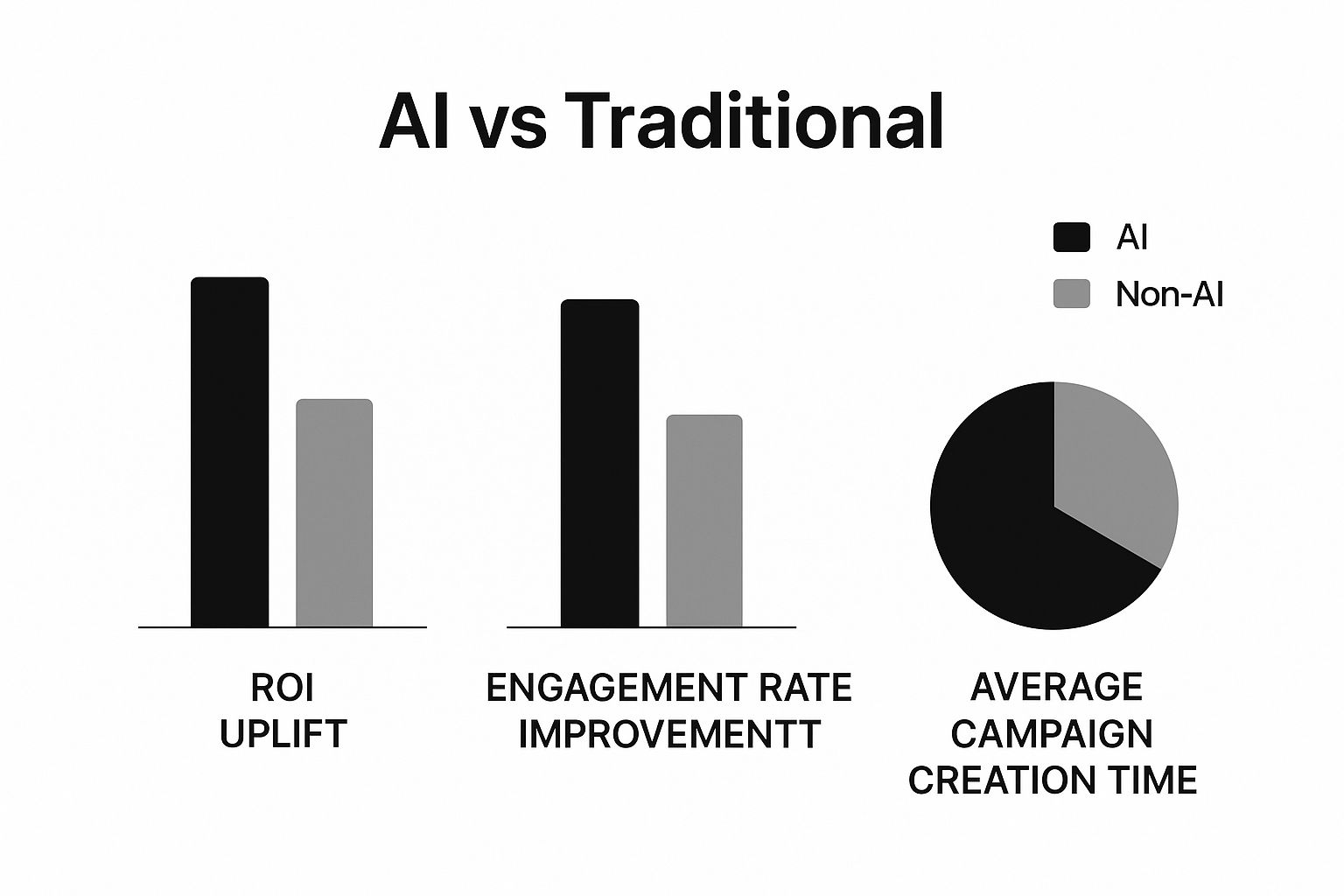
As you can see, AI doesn't just offer a slight boost. It fundamentally rewires what's possible, driving much better results while freeing up your team from the manual grunt work.
From Manual Segments to AI-Driven Journeys
Getting started with this level of personalization can feel like a massive project, but it doesn't have to be. You don't need to flip a switch and go from zero to a fully autonomous system overnight. It’s a gradual evolution.
Most teams start with basic manual segmentation, which is a great first step. But you quickly hit a ceiling on how granular you can get without burning out your team. Once you start layering in AI, your ability to create those individual experiences grows exponentially—and so does the impact.
The real magic of AI in marketing isn't just about showing someone a relevant ad. It's about predicting what that customer will need next and creating a seamless journey that guides them there before they even have to search.
Let's break down how this journey from manual to AI-powered personalization actually plays out.
Comparing Personalization Strategies: Manual vs. AI-Driven
To build a realistic roadmap, you have to understand the trade-offs. Each approach has its own benefits, but also its own technical demands and scalability limits. This table lays out the common stages most marketing teams go through.
| Personalization Level | Method | Scalability | Impact |
|---|---|---|---|
| Basic Segmentation | Manually creating audience lists based on simple rules like location or past purchase category. | Low. Becomes a nightmare to manage with more than a few segments and needs constant manual updates. | Modest. It's better than nothing, but still feels generic and misses individual nuances. |
| Rule-Based Automation | Using marketing automation triggers (e.g., "if user clicks X, send email Y"). | Medium. More scalable than manual work, but the rules are rigid and can't adapt to new user behaviors on their own. | Good. Creates more relevant journeys but can break if a user's behavior doesn't fit the exact path you designed. |
| AI-Powered Personalization | Using machine learning to analyze user data and automatically deliver dynamic content, product recommendations, and offers. | High. The system learns and adapts in real-time, personalizing experiences for thousands or millions of users at once. | Excellent. Drives major lifts in engagement, conversions, and customer lifetime value because it's truly responsive. |
That jump from rule-based automation to AI is where everything changes. It’s the difference between guessing what a group of people might like versus knowing what a specific individual is interested in right now.
Actionable Ways to Implement AI Personalization
You don’t need a data science PhD to put this into practice. Modern AI marketing platforms have made these capabilities much more accessible. Here are three high-impact ways to get started:
-
Dynamic Website Content: Instead of every visitor seeing the same homepage, an AI engine can swap out headlines, images, and CTAs based on their industry, location, or past behavior. A returning customer might see a "Welcome Back!" message with products related to their last purchase. A new visitor from the tech industry? They'll see a case study that’s actually relevant to them.
-
Predictive Product Recommendations: This goes way beyond the simple "customers who bought this also bought..." logic. AI looks at a user's entire browsing history to recommend products they are statistically most likely to buy next. It’s the same tech that powers the recommendation engines on Netflix and Amazon, and it’s a killer way to increase average order value.
-
Personalized Email and Ad Campaigns: With AI, you can automatically tailor the content of an email for every single recipient. The system can pick the best products to feature, adjust the discount offer, and even optimize the send time for when that specific person is most likely to open it. This level of individualization is what drives those huge jumps in open rates and conversions.
Turning Data into Action with AI Analytics
Collecting data is the easy part. It’s knowing what to do with it that separates the winners from the rest. Modern marketing spits out a firehose of information—click-through rates, social media sentiment, page views, you name it. AI analytics is what turns that flood of noise into a clear signal that actually grows your business.
Forget spending weeks buried in spreadsheets trying to connect the dots. An AI-powered analytics platform can instantly spot hidden trends, predict what’s coming next, and show you the true ROI of every dollar you spend. It’s the difference between staring in the rearview mirror and having a clear map of the road ahead.
Moving From Reactive to Predictive Marketing
For years, we’ve relied on historical data to figure out what worked yesterday. AI flips that model on its head. It uses predictive analytics to forecast what will work tomorrow, letting you make smarter, faster decisions that give you a real competitive edge.
This isn't just a niche trend; it's a fundamental shift. A staggering 83% of companies now see AI as a top business priority. The workforce is scrambling to keep up, with estimates suggesting around 97 million people will be working in the AI space by 2025. You can see more AI adoption stats and trends over at Exploding Topics.
So how does AI pull this off? It’s not magic; it’s just better math applied to a few key areas:
- Customer Segmentation: AI goes way beyond basic demographic buckets. It crunches thousands of behavioral data points to create dynamic micro-segments of users who share similar needs and are likely to buy.
- Churn Prediction: By spotting tiny shifts in user engagement, AI can flag at-risk customers long before they hit the cancel button. This gives you a crucial window to step in with a targeted retention campaign.
- Attribution Modeling: AI finally untangles the messy knot of customer touchpoints. It can accurately assign credit to the channels and campaigns that are truly driving conversions, not just the last thing someone clicked.
Comparing Traditional Analytics with AI-Powered Insights
The gap between a standard analytics tool and an AI-driven one is huge. One tells you what happened. The other tells you why it happened and what you should do next.
Here’s a quick breakdown of how they stack up in the real world:
| Capability | Traditional Analytics Approach | AI-Powered Analytics Approach |
|---|---|---|
| Trend Analysis | You manually eyeball charts, hoping to spot a pattern. It’s slow and riddled with human bias. | AI automatically detects emerging trends and anomalies in real-time, often before they’re even visible to you. |
| Budget Allocation | You shift ad spend based on last month's numbers, often pouring money into channels that are already declining. | AI predicts which channels will deliver the highest ROI next month, optimizing your spend before a campaign starts. |
| Lead Quality | You rely on simple, static rules like job title or company size that go stale almost immediately. | AI uses predictive models to dynamically score leads on their likelihood to convert, pointing your sales team to the hottest prospects. |
The goal of AI analytics isn't to give you more charts to stare at. It's to give you fewer, more confident decisions. It automates the "so what?" part of your job, freeing you up to focus on strategy.
Practical Examples of Actionable AI Analytics
Let's ground this in a few scenarios you’ve probably faced. This is how you stop talking about "data" and start getting tangible results.
Scenario 1: You’re Wasting Ad Spend (And You Don't Know It)
You're running ads on Google, LinkedIn, and Facebook. Instead of just tweaking budgets based on last week's cost-per-acquisition, a predictive tool dives deeper. It sees that while LinkedIn has a higher CPA, it’s bringing in leads with a 30% higher lifetime value. The AI automatically reallocates budget from Google to LinkedIn to maximize long-term profit, not just short-term clicks.
Scenario 2: Your Customers Are Complaining (But You Can't Find the Pattern)
You’ve got thousands of survey responses and social media comments. An AI tool using natural language processing (NLP) rips through all that unstructured text in minutes. It discovers that 15% of all negative comments mention a confusing checkout process. Boom. You now have a data-backed reason for your product team to prioritize a UX redesign.
This is especially critical for your sales team. When you can prioritize their efforts with this level of clarity, everything gets more efficient. For a deeper look, check out our guide on applying AI to lead scoring to see how you can focus your team on the deals most likely to close.
Building Your Actionable AI Marketing Plan
Alright, let's get down to brass tacks. Moving from "AI in marketing is cool" to actually using it requires a real plan. It's incredibly easy to get distracted by all the shiny new tools, but a structured approach is the only way to get results instead of just spinning your wheels.
The secret? Start small. Prove the value quickly, then expand what works.
This isn't about blowing up your entire marketing department overnight. A smart AI integration starts with a single, well-defined problem. Pick one specific headache—maybe your content creation is painfully slow, or your lead follow-up is leaky—and find an AI tool that directly solves that. This focused attack is way more effective than trying to boil the ocean with some massive, all-in-one AI platform right out of the gate.
Getting Your Team On Board
Bringing AI into your marketing mix is as much a cultural shift as it is a tech one. You can have the best tools in the world, but without your team's buy-in, they'll just collect dust. The goal is to position AI as a collaborator, not a replacement. It’s the new intern who handles the tedious, repetitive work, freeing up your team for big-picture strategy and creative thinking.
The biggest pitfall isn't the technology failing; it's leaning so hard on automation that you forget about human oversight. Remember, AI is here to assist your team's judgment and expertise, not replace it.
To build this kind of culture, you need to focus on education and empowerment.
- Actually train them: Host workshops that show people how to use the new tools for their actual daily tasks.
- Let them experiment: Create a safe space where team members can test prompts and workflows without worrying about messing up.
- Shout out the wins: When someone uses AI to knock it out of the park—like creating a high-performing ad or a killer report in half the time—celebrate it. Make it visible. Success breeds momentum.
Your First AI Implementation Checklist
To make this tangible, here’s a simple checklist. This isn’t about becoming an AI guru in a week; it’s about taking methodical steps to build a solid foundation.
| Phase | Action Step | The Old Way | The AI-Powered Way |
|---|---|---|---|
| 1. Identify | Pinpoint one high-impact bottleneck. | Guessing based on team complaints. | Analyzing performance data to find the weakest link (e.g., dismal email open rates). |
| 2. Pilot | Pick one tool for a 30-day trial to solve that one problem. | Committing to a year-long contract after a slick sales demo. | Using a small, focused pilot to prove ROI before making a big investment. |
| 3. Measure | Define one or two clear KPIs to track success. | Vague goals like "make better content." | Specific metrics like "cut blog drafting time by 50%." |
| 4. Scale | If the pilot works, gradually roll the tool into the team's workflow. | Forcing a new tool on everyone at once, causing chaos. | Expanding access to other teams based on proven success stories. |
This phased approach takes the risk out of the equation and builds confidence across the board. It shifts the entire conversation from a hypothetical "what if we..." to a data-backed "look what we did." By starting small and proving the value, you create a sustainable path for making AI a core part of your marketing machine.
Ready to build your actionable AI marketing plan with a platform that grows with you? marketbetter.ai integrates content generation, campaign optimization, and personalization into a single, powerful system designed to deliver measurable results. Start your journey with marketbetter.ai today.
Article created using Outrank